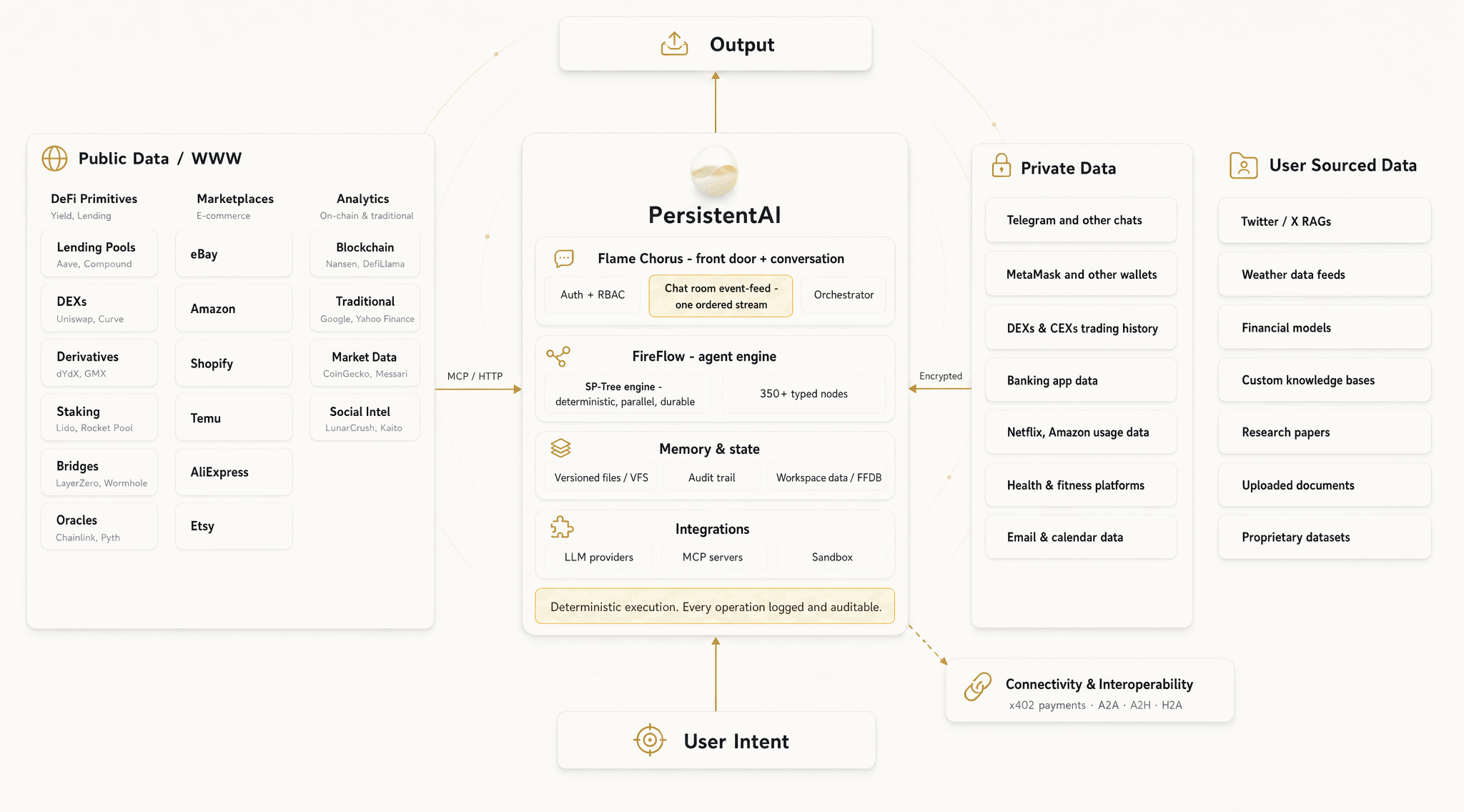
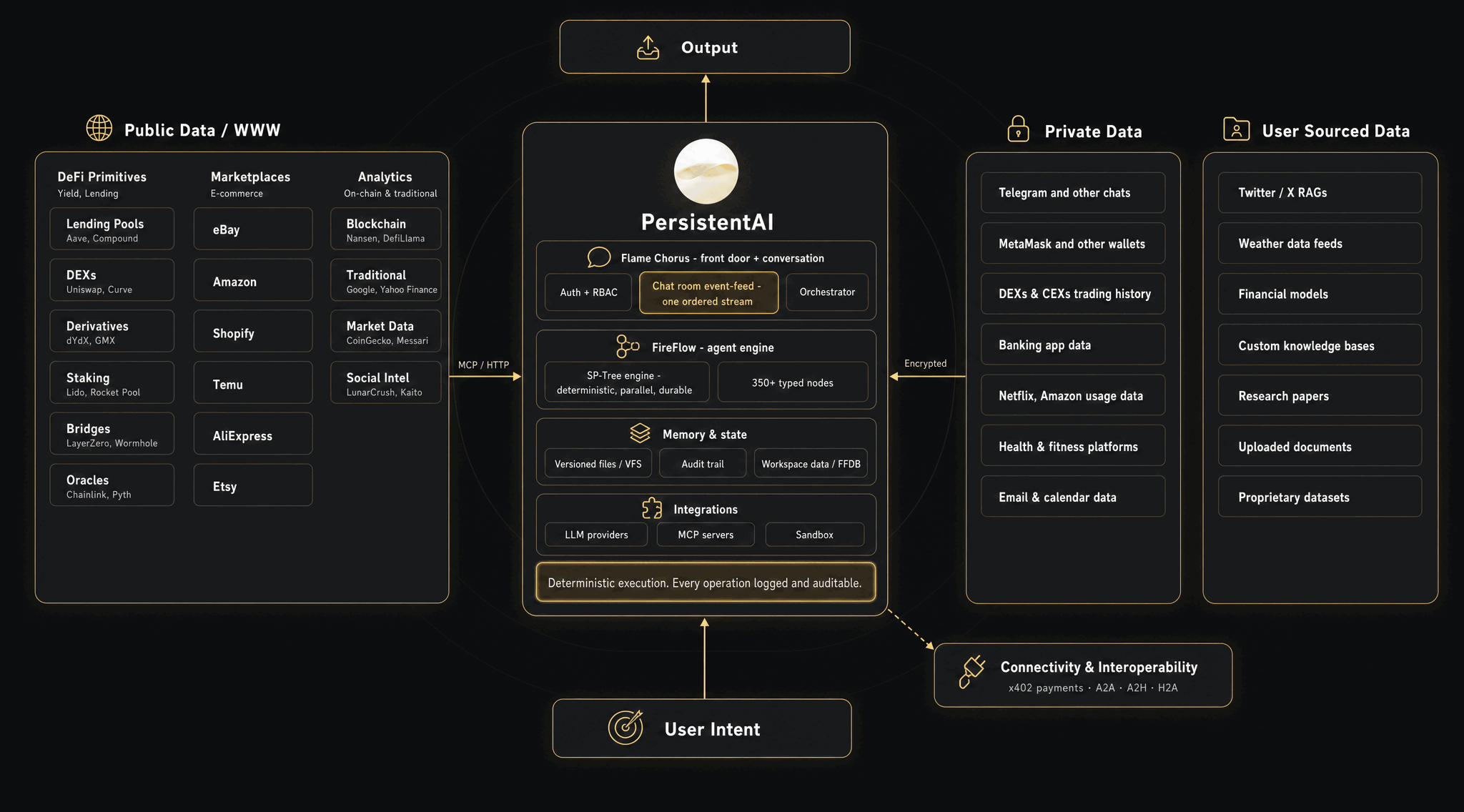
Most AI agents fail quietly — losing context, mishandling errors, drifting from their intended behavior. PersistentAI is the execution layer that prevents that: persistent memory, fault tolerance, and guardrails built into the runtime itself.
Building one you'd trust with a real customer, real money, or an irreversible action is not.
The difficulty isn't intelligence — it's infrastructure. Agents that run beyond a single interaction need durable execution, persistent memory, identity and permissions, audit trails, and operational visibility. Most teams build this from scratch, once per project, under pressure.
PersistentAI is that infrastructure. Already built.
Every team building a production agent hits the same ten stages on the way from prototype to something you can trust. They're predictable — and each one is already solved in the runtime.
Stage
Problem
FireFlow solution
1
Crash recovery
DBOS durable execution — checkpoint every step in PostgreSQL.
2
Exactly-once
Atomic checkpoint + operation in the same PostgreSQL transaction.
3
Observability
25+ event types, full audit trail, real-time WebSocket delivery.
4
Human-in-the-loop
Durable pause via DBOS.recv() — survives restarts, for hours or weeks.
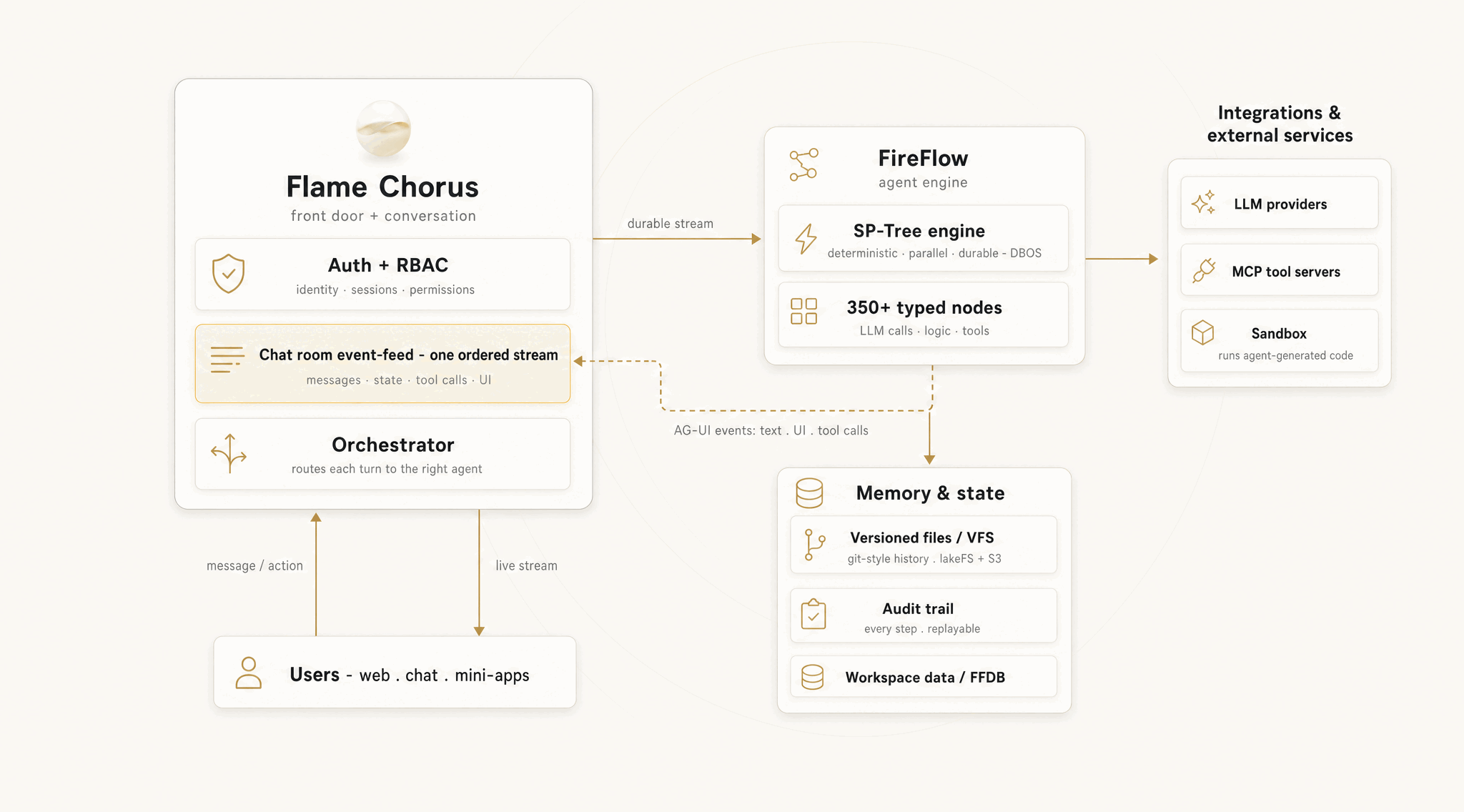
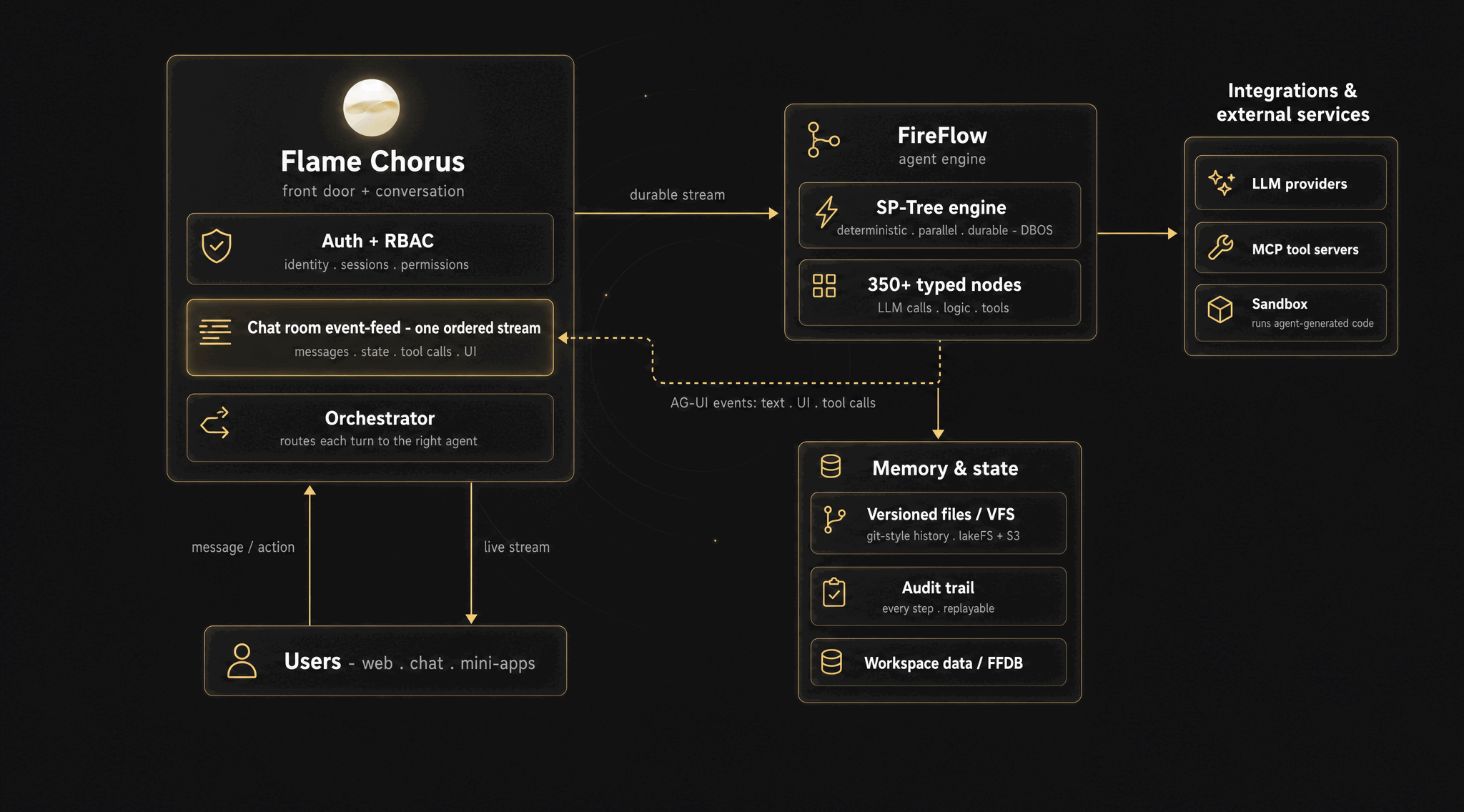
A user message lands in a Flame Chorus chat room and becomes one ordered entry in that room's feed. The orchestrator routes the turn to the right agent; FireFlow runs the agent's logic, calls models and tools, and writes results back into the same feed as live AG-UI events — text, generative UI, and tool calls — that stream straight to the user. Memory Tree keeps the whole thing durable underneath: every message, file, record, and decision is persisted as it happens. Everything starts and ends in the room.
Each part of the platform earns its place. Here's what every piece buys you — and the failure mode you inherit without it.
Feature
What it enables
What happens without it
Durable engine
If something goes wrong mid-operation, the agent continues from the last saved point.
The user writes to the agent, it never responds, and forgets the request until the user writes again.
Visual editor
Fast iteration. Non-technical team members can change and adapt the agent — a product team can assemble one in a day. No CI/CD overhead, no deploy step.
Every small improvement goes through developers and the full request-to-deploy pipeline. Testing hypotheses in a single day becomes impossible.
Event sourcing & audit
Every agent execution is stored and replayable in the editor — detailed debugging plus an audit log.
Users report that something is off — the agent answers differently than expected, or not at all — and there is no way to understand why.
Human-in-the-loop
Approval of major operations. The agent’s full state is preserved and it waits until the user approves or rejects the action.
The agent sends money to the wrong place, or the amount is wrong by mistake. The user never sees it coming and cannot prevent it.
Request routing between agents
Manager agents and invisible router agents orchestrate requests to the right agents and sub-agents, each owning its own integrations.
One agent wired to everything at once: huge per-response cost and a high chance of hallucination.
Vault, access control, versioning
Secret protection, client isolation, and rollback to any previous version of the graph or agent.
Building agents inside an organization where several people work on the same agent becomes impossible.
Memory Tree — 4 layers
Chat history, VFS files, structured data in variables, and execution history. Everything the agent does is preserved across four layers and reusable later.
The agent forgets context after a few messages and cannot handle medium- or high-complexity tasks.
Messenger with agents
Several agents in one chat room, with generative UI as part of the interaction.
A bare chat interface that is sometimes less convenient than a classic UI.
Most agents forget the moment a session ends. PersistentAI treats memory as foundational infrastructure, not an afterthought — Memory Tree is a set of layers that work together so agents retain context, history, and state across every interaction.
Every session is a single, ordered, append-only feed. Messages, state changes, tool calls, and the on-screen UI all live in that one stream — which also drives live sync, rendering, and the tool-call lifecycle. State moves as JSON-Patch deltas. Reload a week later and the session rebuilds exactly as it was, from the same source it always renders from. No separate history path. No drift.
Anything an agent produces or modifies — documents, data, or the agent's own definition — is a versioned file with branches, diffs, and rollback to any point in time. Built on a virtual file system backed by lakeFS and S3. Every write is durable and exactly once.
Agents read and write structured records directly within their workspace — JSON documents, key-value state, CSV tables, queryable data — without standing up or managing a separate database. The data layer is built in.
Every step an agent takes is recorded as it happens: what ran, what it received, what it produced. The execution log lives in Postgres and supports deterministic replay — use it for debugging, hand it over as an audit record, or reconstruct exactly what happened and why.
A graph layer stores facts as triples and indexes them — including for RAG — so agents can retrieve and reason over their own accumulated knowledge, not just the last few messages. Rolling out now.
The agent's logic, its tools via MCP, and every memory layer live together in FireFlow. The agent's brain and its memory are never two separate systems.
A server can restart mid-task and the agent resumes exactly where it stopped — no repeated steps, no lost progress. Execution is durable and exactly-once, built on DBOS with automatic crash recovery.
Independent branches execute simultaneously, yet the same inputs always produce the same outputs. Flows compile to a series-parallel tree (SP-Tree engine), so determinism is a property of the architecture, not something you have to engineer separately.
The agent knows who's asking, what they're permitted to do, and when to stop and wait for a human before taking an irreversible action. Untrusted code runs in a sealed sandbox. Authentication, role-based access control, human-in-the-loop checkpoints, and sandboxed execution are built into the runtime — with separate owner and caller identities so permission boundaries are unambiguous.
Users interact in plain language. The agent responds with live buttons, forms, and charts rendered directly inside the conversation — not in a separate interface. Built on the open AG-UI protocol, with support for multi-agent rooms.
Connect any tool, model, API, or data source. Expose your own agents the same way. Over 320 typed building blocks, with open tool protocols — MCP supported both inbound and outbound.
Finance, identity, compliance — environments where "the AI made a mistake" is not an acceptable answer. PersistentAI is built for exactly that accountability.
Plenty of tools cover a slice of this. FireFlow + Flame Chorus is the one that covers the whole agent lifecycle — visual graph, durable execution, event stream, sandbox, MCP, audit/replay, and a chat layer — in a single architecture. Green is a strength, yellow is an area we're still maturing, red is a genuine gap. We've kept ours honest.
Parameter
FireFlow + Flame Chorus
Langflow + Temporal
n8n
Claude Code
Solution type / product class
A unified agent platform: visual graph, durable execution, event stream, sandbox, MCP primitives, audit/replay, and a chat layer within one architecture.
A combination of a visual builder and a durable workflow engine; requires separate integration between canvas, runtime, observability, access control, and deployment.
A low-code / workflow automation platform with a large number of integrations, AI nodes, and agent workflows.
A developer tool: helps programmers read code, modify files, run commands, and build individual agents / automation scripts.
Primary use case
A platform for creating, launching, managing, and operating multiple agents.
An architectural stack: Langflow as a visual canvas, Temporal as a durable runtime.
Automation of business processes and integrations; well-suited for workflow automation and AI automations.
A coding assistant / agentic developer tool; strong for writing, modifying, and debugging code.
Visual builder
Visual graph connected to execution semantics, typed ports, and runtime.
Langflow covers the visual canvas, but the runtime needs to be integrated separately.
Strong visual workflow builder with many ready-made nodes and integrations.
No full visual builder for business users; the main interface is terminal / IDE / dev environment.
Durable execution
Durable execution built into the platform runtime; execution state, replay, and recovery are part of the architecture.
Temporal provides a mature durable workflow engine, but it needs to be properly connected to Langflow graph semantics.
Has execution history, retries, queue mode, and scaling, but this is workflow-automation durability rather than full agent-grade durable execution.
Durable execution for enterprise agents needs to be designed separately; Claude Code is not a production runtime.
Builder + runtime integration
Builder and runtime are part of one system.
Requires a separate integration layer: mapping, checkpointing, replay, versioning, and permissions.
Builder and runtime are already integrated within the platform.
No builder + production runtime integration; the agent requires separate deployment and orchestration.
Multi-agent orchestration
Supports master-agent / sub-agent architectures and flow reuse.
Possible, but requires independent orchestration design.
Supports multi-step workflows and AI Agent Tool nodes.
Can be implemented programmatically, but orchestration and management remain entirely with the developers.
Chat / end-user layer
Flame Chorus provides multi-agent chat, ACL, HITL, and context management.
No full chat backend; requires separate implementation.
Has AI/chat capabilities, but the main focus is process automation.
No ready-made user-facing chat layer.
Generative UI
End-to-end support. The agent emits UI as an AG-UI tool call, and the frontend renders it via json-render. Interactive forms, two-way state, both ephemeral and persisted via the event log. 16 ready-made domain components (balance, transactions, invoice/payment request, cart, map, and more).
No native support. Langflow Playground / embedded chat are text-chat interfaces; Temporal UI is not an end-user interface. Generative UI would be a separate frontend layer.
No native support. Chat Trigger provides a text-chat interface; interactive UI needs a custom frontend on top of workflows.
No native support. Claude Code is a terminal / IDE agent with text or markdown output. It can generate UI code as an artifact, but does not render live interactive UI inside its own chat.
Eval / quality gate
Can be implemented through separate flows; enterprise packaging requires further development.
Requires a separate eval component.
Has built-in AI evaluations.
Custom tests and eval scripts are possible, but there is no centralized lifecycle.
Observability / tracing
Event log, telemetry, and execution events are built in; enterprise observability requires further development.
Langfuse layer provides traces, latency tracking, cost per trace, token usage, and anomaly monitoring.
Execution logs, monitoring, OpenTelemetry, and workflow history.
Has hooks and OpenTelemetry in the SDK, but no unified observability platform.
LLM routing / proxy
Possible through flow logic; a centralized proxy requires separate packaging.
LLM Proxy layer provides model abstraction, routing, fallback logic, and provider switching.
Routing can be implemented inside workflows.
Requires independent implementation.
MCP / tool governance
Full MCP client-side integration: MCP nodes, .ffmcp manifests, OAuth, and runtime mechanics. The governance layer — version catalog, approval flow, ACL, formal lifecycle — remains an area for further development.
MCP Hub provides a tool catalog, versioning, approval process, and deprecation lifecycle.
Strong ecosystem of integrations and credentials.
Tool governance needs to be implemented independently.
Sandbox / execution isolation
OpenSandbox, isolated environments, secrets, and access policies.
Requires separate sandbox implementation.
Has execution isolation, but no full agent sandbox.
Uses the developer’s local environment; production sandboxing must be built separately.
Access control / secrets
Built-in OAuth 2.1 server with PKCE, Dynamic Client Registration, and scoped tokens. Policy-based RBAC with roles, owner hierarchy, and isolated user scopes via Flame Chorus. Vault-based secrets with encryption at rest. Federation with external IdPs (SAML, OIDC, SCIM, LDAP) remains an area for further development.
Requires unifying the security models of different components.
Open protocols in and out — MCP, AG-UI, A2A — so you build with the ecosystem instead of betting everything on one model or vendor. Source-available under BUSL-1.1.