

Visual Flow Builder
Build AI agents with drag-and-drop interface. Perfect for non-technical builders and visual thinkers.
Redefining commerce for the AoA — the Age of Agents

Build AI agents with drag-and-drop interface. Perfect for non-technical builders and visual thinkers.
Programmatic control with TypeScript decorators and type-safe APIs. Full control for developers.
Rich port types including primitives, arrays, objects, streams, and enums with runtime validation via Zod.
Backend execution engine supports concurrent execution with real-time event subscriptions and debugging.
Integrated with tRPC and Effector for end-to-end type safety. Real-time updates via WebSockets.
Easily build, deploy, and scale using Docker and docker-compose. Containerized deployment simplified.
Define nodes with intuitive decorators for inputs, outputs, and configurations. Rapid development.
Horizontally scalable with DBOS durable workflows and PostgreSQL. Automatic recovery guaranteed.
Full API documentation, architecture guides, and examples for building sophisticated workflows.
PersistentAI is an open source deterministic orchestration (DO) framework for building AI agents and automation systems with complex, verifiable logic. It is engineered for mission-critical, high-load operational environments — such as financial back-office systems, user intent processing, and agentic commerce — delivering fault-tolerant, deterministic flows and enterprise-grade reliability.
The framework addresses a fundamental deficiency in the contemporary AI stack: the absence of a deterministic orchestration layer between probabilistic foundation models and mission-critical end-user applications. Without such a layer, AI agents remain structurally unreliable for any operation involving money, identity, or irreversible state changes. PersistentAI provides that layer.
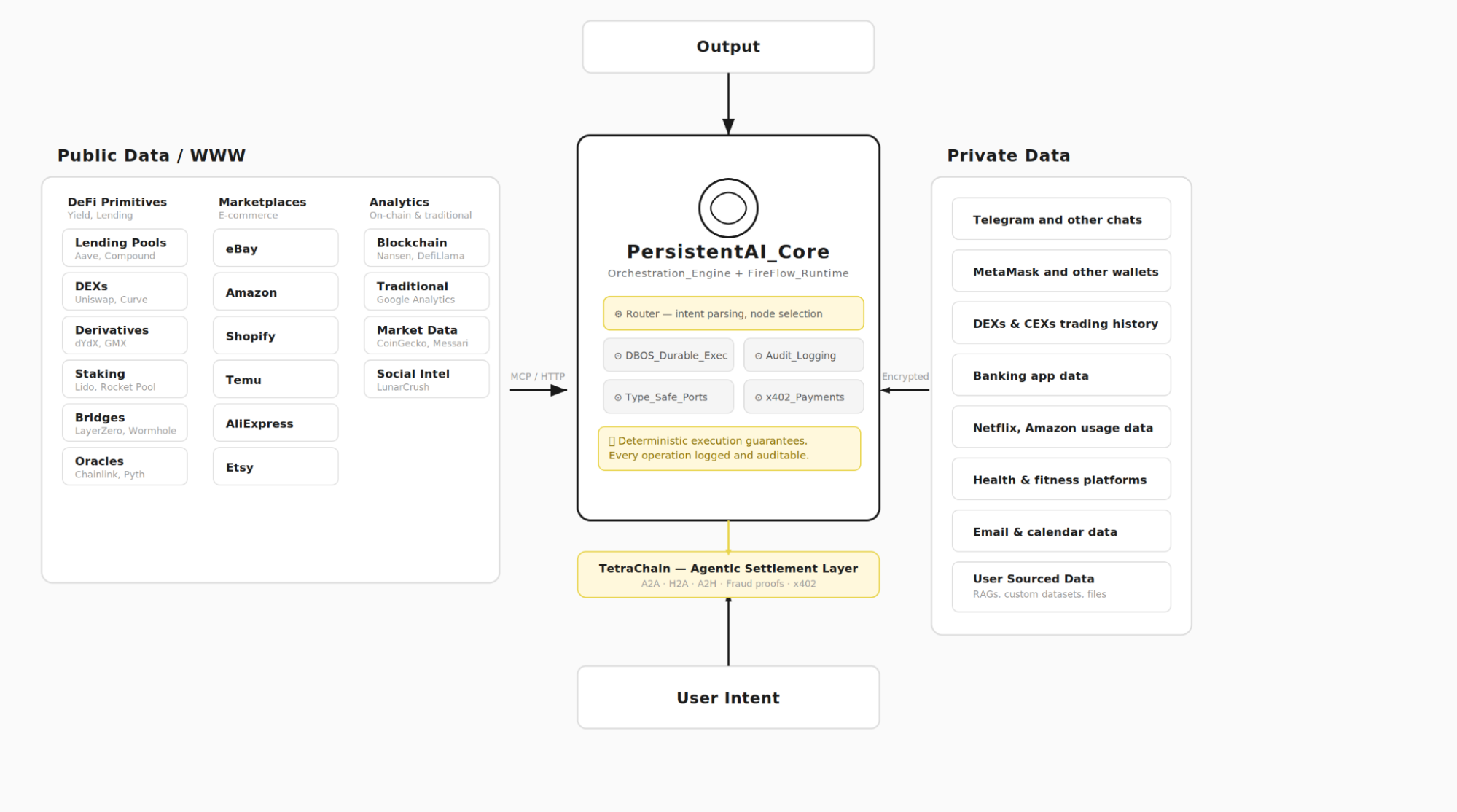
PersistentAI spans the core functional layers of the agentic AI stack — providing the runtime, orchestration, and enrichment foundation on which agentic systems operate. It bridges AI logic, protocol interoperability, workflow orchestration, and tool integration into one cohesive execution layer.
The execution engine at the core of PersistentAI is FireFlow — a deterministic orchestration runtime with exactly-once execution semantics via DBOS, eliminating the hallucination and non-determinism risks inherent in generative AI. This architecture enables the deployment of AI agents in high-stakes sectors such as finance and identity, where structural reliability is a non-negotiable requirement.
As AI agents proliferate across the financial sector — both customer-facing co-pilots and internal digital employees — "agent sprawl" creates operational chaos. Without deterministic orchestration, institutions face catastrophic risks from AI errors in critical operations. PersistentAI serves as the central nervous system for post-AI financial infrastructure, from user intent-driven UX to back-office process automation.
From the institutional viewpoint, PersistentAI enables organizations to build and deploy custom agents for any business logic — whether loan advisory, investment recommendations, fraud detection, or account management. Once integrated into existing chat interfaces, a smart routing assistant automatically invokes the right specialized agent based on customer intent, delivering precise, context-aware responses in real time. This constitutes a single conversational entry point that connects customers to dozens of purpose-built AI capabilities — without managing separate bots or complex handoff logic.
PersistentAI provides a visual flow builder for back-office teams to design, deploy, and manage AI agents without writing code. Business logic is configured through drag-and-drop nodes, making it straightforward to create, modify, and scale intelligent workflows across departments. Every operation is logged and auditable, supporting deterministic execution for high-value operations such as trading or settling transactions.
The platform integrates the following functional systems, each essential for reliable agentic infrastructure in regulated environments:
This infrastructure allows for the dynamic composition of structured financial products from DeFi primitives, all orchestrated by AI. It must be noted that without formal deterministic orchestration, allowing probabilistic generative AI models to compose structured products exposes the organization to extremely high risks resulting from models hallucinating in mission-critical situations. This underscores the non-negotiable importance of DO platforms such as PersistentAI.
PersistentAI introduces what we term User Intent Orchestration (UIO): the paradigm shift from reactive navigation across fragmented applications to proactive, intent-driven fulfillment via autonomous economic agents. UIO moves beyond menu-driven interfaces to a proactive, contextual experience. The system interprets a user's broader goal and automatically orchestrates the necessary services, data, and execution steps across all relevant systems. This transforms complex multi-step workflows into a single, fluid conversation.
UIO enables institutions to deploy Autonomous Co-pilots that shift the user's role from active operator to strategic overseer. Users delegate routine and complex tasks — optimizing savings, rebalancing portfolios, identifying optimal lending rates — to a trusted AI agent. This creates a persistent engagement layer where the co-pilot acts on the user's behalf, deepening reliance and freeing users from manual operational burden.
UIO platforms, with user consent, securely aggregate and analyze data from across a user's financial ecosystem — checking accounts, investments, crypto wallets, and third-party services. This unified intelligence enables radically more insightful decision-making, identifying hidden opportunities or risks and optimizing the user's entire financial position rather than offering isolated, product-specific suggestions.
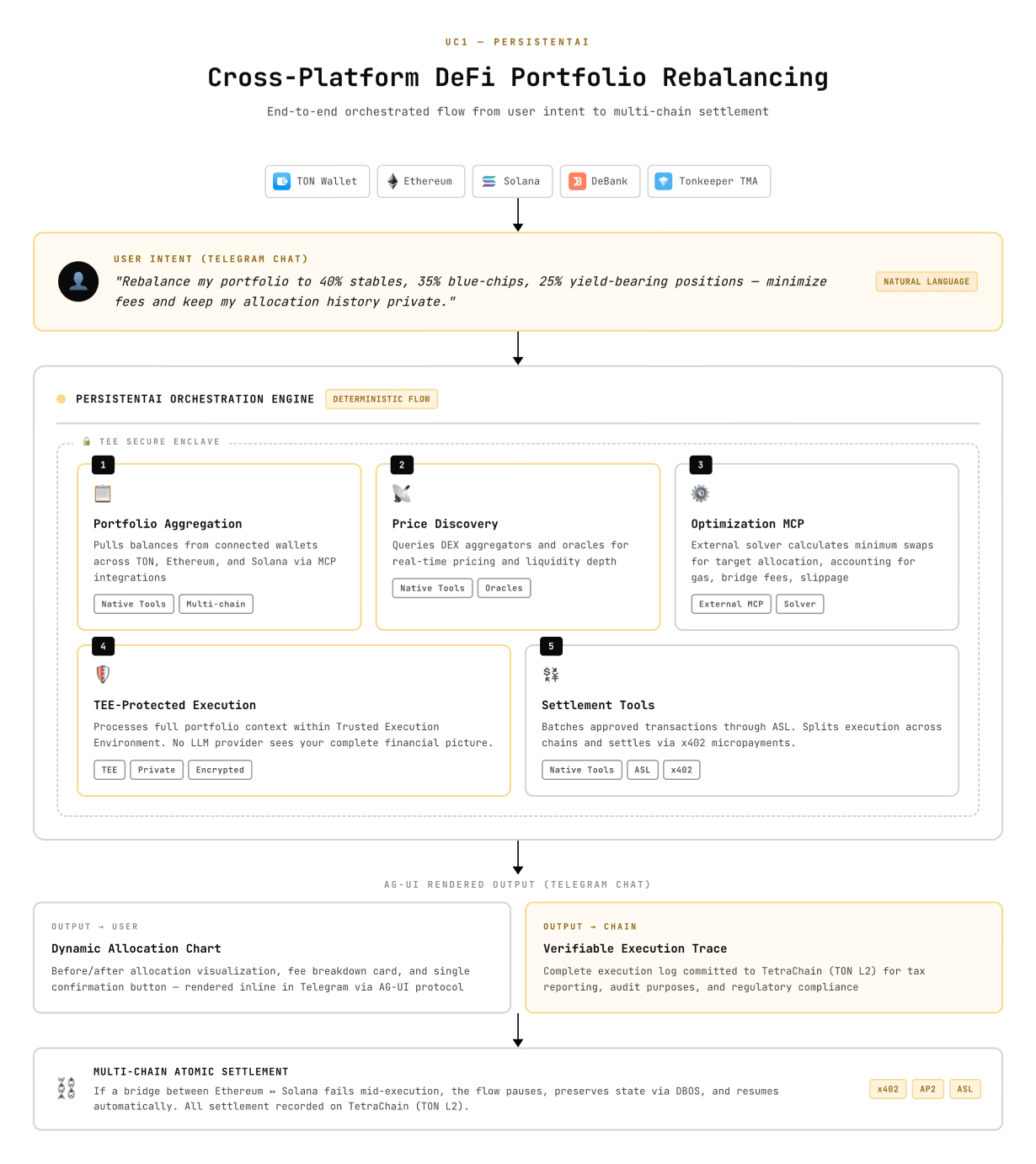
Concurrently, back-office AI agents act as digital employees, automating tasks in compliance, risk management, and treasury operations with significant efficiency gains. This advances the model of the "agentic institution" where human employees orchestrate teams of AI agents that execute back-office and administrative tasks on their behalf. Institutions not adopting the agentic stack for back-office automation risk becoming uncompetitive when compared to leaner and more agile digital-native competitors.
BPO delivers measurable operational improvements: real-world implementations demonstrate cost reductions exceeding 30% while handling increased volume, data accuracy improvements from 92% to 99.3% in document processing, and handling time reductions of 78%. Adaptive process orchestration allows institutions to dynamically adjust workflows, identify bottlenecks, and continuously optimize processes in response to changing regulatory and market demands.
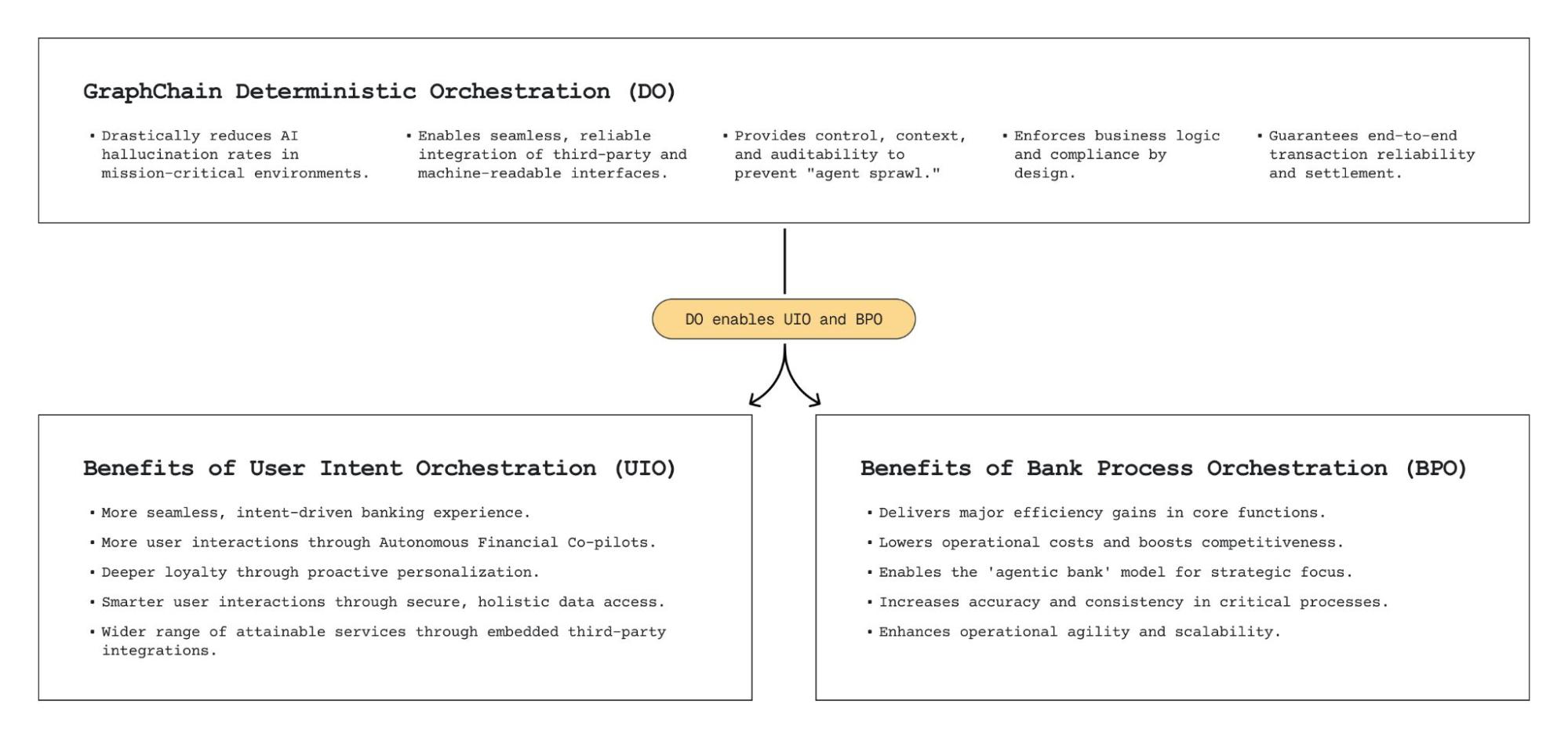
The orchestration engine for financial AI requires guarantees of correctness, auditability, and resilience. FireFlow's architecture — emphasizing deterministic flows, type-safe data systems, and secure, auditable runtime environments — is engineered for this purpose. It ensures orchestration decisions are reliable, side-effect-free, and compliant, significantly mitigating the "black box" risks associated with non-deterministic AI in financial contexts.
The following properties are not features added to a chatbot; they are foundational properties of an execution engine designed for economic activity:
PersistentAI includes a built-in Git-native file system for AI workflows — the Virtual File System (VFS), powered by lakeFS. Every file change is a versioned commit with the same branching, diffing, and rollback semantics as Git, applied directly to data. This is not just storage — it is the persistence layer that makes AI pipelines reproducible, auditable, and collaborative.
VFS operates under the same DBOS exactly-once guarantees as the execution engine. All file writes, moves, and deletes are durable workflows — no partial writes, automatic retry on failure, full audit trail.
FILE_MODIFIED, BRANCH_CREATED, COMMITTED, and more) can automatically spawn flow executions. Drop a file into a workspace and a pipeline runs..fflow directories stored in VFS contain the complete flow definition. Flows are versioned, diffable, and shareable like source code.FireFlow is PersistentAI's source-available DO framework for building AI agents and automation systems with complex, verifiable logic. It is engineered for mission-critical, high-load operational environments, delivering fault-tolerant deterministic flows and enterprise-grade SLAs.
FireFlow's functionality is delivered through five integrated systems working in concert:
Integration with external systems is designed for extensibility. Any machine-readable service, API, or data source can be integrated through one of three approaches:
@Node, @Input, @Output), developers define node metadata and port configurations with minimal boilerplate. The framework handles TypeBox/Schema validation, dynamic UI generation, and port-to-port data mapping automatically.While PersistentAI is platform-agnostic in its core architecture, Telegram represents a particularly compelling deployment substrate. With over 1 billion monthly active users and a thriving ecosystem of Mini Apps (TMAs), Telegram constitutes one of the richest environments for encapsulating and resolving user intents at scale.
PersistentAI integrates Telegram's TMA and public group ecosystem through bidirectional transformation: any TMA, data source, or external service becomes a composable FireFlow node with defined I/O ports and an x402 payment endpoint — while any agentic flow built on the platform can itself be deployed as a TMA. This creates compounding network effects: each new node increases the value of the orchestration engine's compositional surface, and each deployed TMA generates x402 revenue for its component creators.
The AG-UI Protocol (Agent-Generated User Interface) enables AI agents to propose context-aware UI components — charts, product cards, forms, confirmations — rendered in real-time within the Telegram chat interface. Every front-end element is a deterministic wrapper around existing node output ports and fields, not probabilistically generated code.
The Agentic Settlement Layer (ASL), powered by TetraChain, serves as the high-throughput payment rail for executions happening throughout the PersistentAI ecosystem. Every node operates as an independent economic agent via an x402 port, facilitating autonomous, per-inference micropayments. This framework enables the tokenization of inference, where AI logic and datasets are represented as NFTs with automated revenue splits settled instantaneously on-chain between providers, creators, and owners.
The result is that a user types a complex, multi-constraint request into a single Telegram thread, and the orchestration engine decomposes it into parallel execution across dozens of autonomous nodes, settles micropayments to every economic participant, and renders an interactive, auditable result — all without the user leaving the chat.
Clone the repository and install dependencies:
git clone https://github.com/Persistent-AI/fireflow.git
cd fireflow
pnpm install
pnpm buildStart the database using Docker Compose:
docker compose -f docker-compose.yaml up -d && \
docker compose -f docker-compose.vfs.yaml up -dRun migrations to create the necessary database schema:
pnpm run migrateStart the development environment:
pnpm run dev📖 For detailed installation guides, see Developer Docs.
🎨 For the visual flow editor, see User Guide.
| Resource | URL |
|---|---|
| Documentation | docs.persistentai.org |
| API Reference | docs.persistentai.org/api |
| Visual Editor Demo | wl.persistentai.org/agent-editor |